Your own footageGuide
Research your ad library through read-only access
Short answer
Research existing ads by preserving source IDs, dates and creative mappings before interpreting patterns. Compare the opening seconds of stronger and weaker examples within the same reporting context, then state hypotheses for production. Keep account access read only, separate public library observations from owned-account metrics and record missing footage instead of inventing a match.
Distinguish the sources you are reading
A public ad-library entry and an owned-account report answer different questions. One may show a visible creative and public metadata; the other may contain supplied delivery metrics. Do not merge them into a single evidence claim without recording where each field came from. Keep observation, comparison and production recommendation separate so a visible pattern does not become an unsupported performance conclusion.
In our production in October 2026, ad-account analysis is read only and source matching remains a separate task. ai ad workflow small business gives the small-business context. This guide explains an evidence-preserving research method, rather than a recipe for acquiring account credentials or changing campaign settings.
A hypothetical researcher notices a shoe close-up in a public ad and also receives an owned-account export. Those records can inform different questions, but the public entry does not prove which creative caused a result in the export. Preserve each source and its context. Describe the close-up as an observable presentation choice, then propose a bounded production experiment or inspection. Research remains read-only while the team decides what to make next.
Record ad ID, source URL or report path, observation date, report window and the media file associated with the row. If the source has no usable media, mark that limitation. A thumbnail alone may not reveal what happens in the first seconds.
Keep campaign and creative identifiers distinct. Several report rows can point to one creative, while one ad can contain elements that do not reduce to a single video file. Our October 2026 source-matching method excludes cases that cannot be matched reliably rather than forcing them into the clip analysis. This protects the later conclusion from resting on a guessed relationship between a number and a piece of footage.
| Check | Suggested action |
|---|---|
| Source | Distinguish public and owned reports |
| Mapping | Link rows to actual creative |
| Comparison | Keep context and definitions visible |
| Handoff | Deliver hypotheses without account changes |
Source: Turntake editorial checklist (proposed), October 2026.

Compare openings within a defined context
Choose stronger and weaker examples using a clearly defined field from the supplied report. Keep date range, market and relevant delivery context visible. Do not invent a universal threshold or treat an unexplained ranking as a creative verdict.
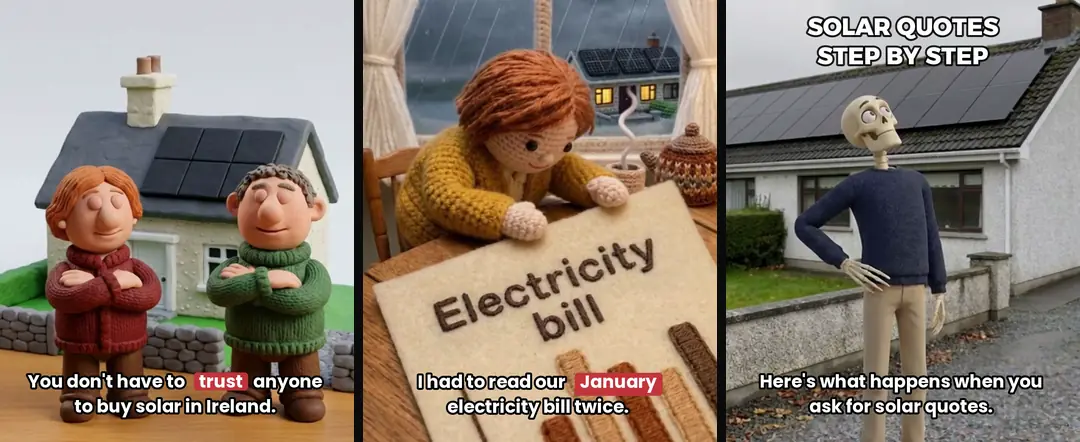
Then review the opening seconds without the metric labels. Describe what is visible: product action, speaking face, question, reveal or static scene. In our production in October 2026, opening research compares both ends of a set and treats the resulting patterns as hypotheses. The product itself can carry the opening. A speaking face should not be assumed to be the only possible source of attention.
- 01Map source fieldsPreserve IDs and report window
- 02Review both endsDescribe openings without rank labels
- 03Match actual footageRetain missing-source cases
- 04Write production hypothesisKeep account changes separate
Code the visible opening independently
Give reviewers a small vocabulary and the same clip interval. Ask each to describe the visible device without seeing the stronger-or-weaker grouping. Compare disagreements and refine the categories before interpreting them.
This is a recommended way to reduce expectation-driven descriptions. It does not turn a small sample into representative research. A reviewer may disagree because two mechanisms occur together, because the clip interval is incomplete or because a category is too vague. Keep those reasons in the record. Do not settle a difficult case by choosing whichever label makes the desired hypothesis look more consistent.
Match research examples to usable sources
An ad can suggest a useful opening while its raw footage remains unavailable. Record the gap instead of treating the finished ad as a clean source clip. Burned captions, product labels and music may prevent direct reuse.
Our October 2026 library method checks actual files and project sources, because names such as “no titles” can still hide graphics. Log footage in ad edits: transform or set aside covers footage logging. Build a product video shot list from proof needs covers a shot list when research reveals a missing demonstration. Film phone b-roll that is useful in an ad edit covers filming phone b-roll. Those are production responses to the evidence gap; they do not retroactively make the original source match complete.
- Available evidencePublic creativePermitted conclusionVisible content description
- Available evidenceOwned report rowPermitted conclusionDefined metric observation
- Available evidenceMatched raw footagePermitted conclusionReuse candidate
- Available evidenceMissing mediaPermitted conclusionUnresolved research limitation
Turn a pattern into a bounded hypothesis
Write what you propose to change, why the observed examples suggest it and what else might explain the difference. For a hypothetical workshop ad, the hypothesis might be that showing the part moving immediately makes the mechanism clearer than a static room opening. That is a production idea, not an established result.
Keep the body and factual claim controlled if the intended question concerns only the opening. Record the intended comparison before making the variant. A later report can then examine the specific question rather than choosing a favorable story after seeing the outcome. Do not copy private report values into public content or use them to invent general benchmarks.
End with a research handoff, not an account change
Deliver the source map, coded openings, proposed hypotheses and missing-media list. Keep the recommendations separate from permission to upload, activate or alter delivery. In our October 2026 workflow, a person handles account changes and new items begin paused.
Turntake’s content library approach describes Turntake’s content-library approach. The method here can help a team understand its own material while keeping account authority outside the analyst’s job.
Before closing research, ask another operator to trace one conclusion back to its report row and visible clip. If the mapping cannot be followed, narrow the conclusion or repair the evidence record. A short, traceable hypothesis is more useful than a confident creative ranking whose source relationships cannot be reconstructed.
Keep a missing match visible
A hypothetical report row may show a strong opening metric while the associated media URL no longer works. Retain the row for report context, but leave the visual classification blank. Do not choose a similar-looking clip from another ad and call it a match. The research summary can state that the metric observation exists while the opening remains unreviewed. This preserves the difference between unavailable evidence and evidence that supports a proposed visual pattern.
Who wrote this We made the ads first, for SmartSolar in Denmark, Sweden and Ireland. Then we built Turntake. Where Turntake comes from
FAQ
How should I research ads without changing an account?
Research existing ads by preserving source IDs, dates and creative mappings before interpreting patterns. Compare the opening seconds of stronger and weaker examples within the same reporting context, then state hypotheses for production. Keep account access read only, separate public library observations from owned-account metrics and record missing footage instead of inventing a match.
How do I build a source map before judging creative?
Record ad ID, source URL or report path, observation date, report window and the media file associated with the row. If the source has no usable media, mark that limitation. A thumbnail alone may not reveal what happens in the first seconds.
How do I compare openings within a defined context?
Choose stronger and weaker examples using a clearly defined field from the supplied report. Keep date range, market and relevant delivery context visible. Do not invent a universal threshold or treat an unexplained ranking as a creative verdict.
How do I code the visible opening independently?
Give reviewers a small vocabulary and the same clip interval. Ask each to describe the visible device without seeing the stronger-or-weaker grouping. Compare disagreements and refine the categories before interpreting them.