The ad factoryGuide
UGC hook ideas: start with the first three seconds of your own ads
Short answer
The most useful hook ideas are in the first three seconds of your own ads: the ones that stopped the most people and the ones that stopped the fewest. Code them blind, note what the strong ones share, and treat it as a guess to test on a body that already works, not as a rule.
Hooks are the scarce part of an ad library: in one we cut for another brand, we ran out of hooks long before we ran out of clips. This is the method we run in our ad factory before we write a single new hook. For the whole chain, see the full AI UGC workflow.
Most lists of UGC hook ideas are lists of other people’s ads. We won’t give you one, because the hooks that work are specific to a product, a market and a period, and a list won’t tell you which of those you share. What we can give you is the way we look for them: in your own ads, in the first three seconds.
What counts as a hook?
A hook is anything that stops the scroll in the first seconds. A spoken line is one. So is a frame, a movement, a sound, a line of text on screen, or the product itself in the shot. It doesn’t need a face, and it doesn’t need anyone talking to the camera.
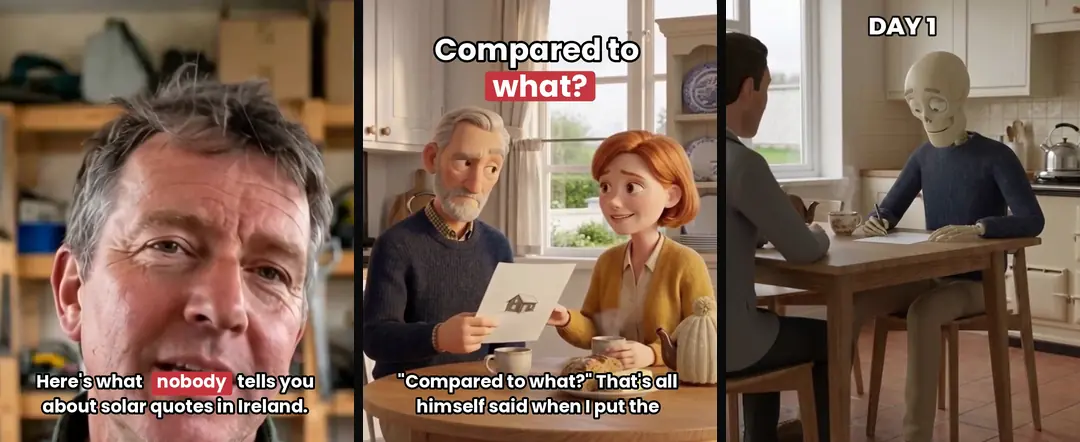
So don’t decide the hook types in advance. Derive them from your own data, and expect surprises, because a team’s habits are not the same thing as what stops people.
A hook is a creative idea; a hook metric is a measurement contract. Name the viewing event, denominator and observation window before comparing openings. The dedicated hook rate and hold rate guide explains that distinction without a universal benchmark. In our production in October 2026, the useful editorial question is whether the opening makes the next beat understandable, while campaign evidence is assessed separately.
The coding sheet
This is the method, in the order we run it.
- Pick the strongest and the weakest ads by hook rate, from the same period and market.
- Cut the first three seconds of each as a strip, one frame every half second, and note the text on screen at one second.
- Shuffle the strips, so nobody can see which came from the top and which from the bottom.
- Give them to two coders who work independently. They can be two people or two separate runs of an AI model. Each builds their own categories from the bottom up, without seeing names or numbers.
- Merge the two sets of categories, measure where the coders agree, and test the categories against the real numbers.
- Then try to disprove the result. Is the metric measuring the opening, or how long people stay? Do length, campaign age, format or retargeting explain it?

Each coder fills in the same fields for every strip.
| Field | What to write down | Why it matters |
|---|---|---|
| Opening shot | What is in the first frame | Often decides the stop |
| First words | The first spoken line, if there is one | A line can stop people without a face |
| Text on screen | What it says at one second | Shows whether the opening works with the sound off |
| Who is on screen | Nobody, a hand, a creator, a crowd | Tests the assumption that a hook needs a face |
| Product visible | Yes or no, and how large | The product can be the hook |
| Change in the frame | A reveal, a transformation, a movement | Motion is a different stop from a line |
| Sound | Voice, music, an effect, silence | Matters for viewers with the sound on |
Source: our own method, October 2026.
Where the coders disagree, your categories are vague, and that is useful to know too. Treat what comes out as hypotheses. The samples are small, and the period and market explain part of any difference. The result is a list of things worth testing, not a rule.
Hooks are the bottleneck in a library
If your footage library is cut from raw files, clips are plentiful and hooks are rare. In a library we cut for a brand outside our own, the number of ads we could build was limited by hooks, not by clips. So count unique hooks instead of clips, and cap how many can come from one creator or one place, so a single face doesn’t fill the bucket. Our rule of thumb is no more than about a third of a bucket from one source, and we haven’t calibrated it.
- Counted in clipsLooks plentifulCounted in unique hooksShows how many ads you can build
- Counted in clipsOne creator can fill a bucketCounted in unique hooksNo source above about a third of a bucket
- Counted in clipsSays nothing about openingsCounted in unique hooksShows where to look next
Old shoots and editors’ project files are good places to look for hook takes, because a person already chose those in and out points. How to repurpose video ads covers how to trace them.
Test a new hook on a proven body
A hook can change without touching the rest of the ad. Keep the body, the part after the hook, edited once and identical across versions, and replace only the opening. Time the new hook’s captions to its own audio.
On talking-head ads, the one move we allow on the face is the hook zoom-out: start zoomed in, hold the first words, and ease out to wide on a chosen word. The full workflow is in How to iterate on winning ads.
Variety, not templates
In our own scripts, sameness was the clearest AI fingerprint. When every script in a batch has the same skeleton, the same turn and the same ending, the machine shows. Across a batch, reuse neither the hook, the turn nor the ending. If two scripts could swap sentences without anyone noticing, rewrite one of them.
Two tells we watch for in every batch. One is a person tilting their head up at nothing. The other is a line that comments on the ad itself, such as I know this sounds like an ad. Self-irony about yourself or the product is fine. Commentary on the ad is not.
We’re building Hook finder Coming for the first step of this method: the first seconds of your strongest and weakest ads, side by side. Early access: we set it up with you. Coming: we’re building it.
When hooks stop working
A hook that stopped a feed last quarter can wear out like any other creative. When a set of ads that used to work slows down, new hooks are one of the fixes, and Creative fatigue on Meta covers the others.
Who wrote this We made the ads first, for SmartSolar in Denmark, Sweden and Ireland. Then we built Turntake. Where Turntake comes from
FAQ
What is a hook in a UGC ad?
A hook is whatever stops the scroll in the first seconds of the ad. It can be a spoken line, a frame, a movement, a sound, text on screen or the product itself. It does not have to be a face talking to the camera. Define your own hook types by coding the openings of your strongest and weakest ads.
What is a good hook rate?
We won’t give you a number, because it depends on your format, placement, audience and period. Compare your own ads with each other within the same period and market, and read hook rate next to what happens after the first seconds. In our own data, a high stop rate alone did not reliably predict how an ad did further down.
Can the product be the hook?
Yes. Do not assume a hook needs a face. Code your own openings and see whether the product, or a change in the frame, does the stopping. Treat what you find as a hypothesis to test in new ads, because the samples are small and the period and market explain part of any difference.
Where do I find hooks if I have no ads yet?
Watch the first three seconds of the ads already running in your category, in the public ad library of the platform you use, and code them with the same sheet. That gives you hypotheses, not proof. Your first tests of your own then give you real data, and the method continues from there.
How many new hooks should I test at once?
Change one thing per test. Put each new hook on the same proven body, so any difference can be traced to the opening, and write down what you expect before the ad is made. We do not give a number of hooks per round, because the right count depends on how much delivery you can give each version.
Sources
- Meta: 3-second video plays checked 10 October 2026
Facts from the sources below were checked on the date shown. Pages change, so read the source again before you rely on it.