Testing and scalingOverview
Creative fatigue on Meta: how to make new creatives without a reshoot
Short answer
Creative fatigue is when the people you reach have seen your ads so often that results slide. The production fix is variety you can make without a new shoot: new hooks on a proven body, new formats from the same research, and library clips reused with a limit, so no two ads look alike.
An ad that worked last month can tire when the same audience sees it, or ads like it, too often. We meet that in our own production in three markets. This page explains what Meta says creative fatigue is, why AI-made ads can tire faster, and four ways to make different ads without a new shoot. It is about production. We give no refresh schedule, no frequency limit and no benchmark, because a fixed number would be a guess without your data.
What Meta says about creative fatigue
Meta’s help page defines creative fatigue as an audience having seen the same creative too many times. People may then be less likely to engage, and each result can cost more. Here is what the page describes, as checked in October 2026.
| When | What Meta shows | What Meta suggests |
|---|---|---|
| Before a campaign is active | A warning before you publish, if Meta predicts fatigue within the first 7 days | Fix the creative before launch |
| After a campaign is active | A “Creative limited” or “Creative fatigue” status in the Delivery column, based on recent exposures of the image or video and on how much a result costs compared with your earlier ads | Create another ad with a new image or video that is materially different from the original; expand your audience; try Advantage+ creative |
Source: Meta Business Help Center, checked October 2026.
Two limits are worth knowing. Meta says the feature is available only for ad sets with one creative, and not for ad sets with Advantage+ catalog ads, dynamic creative or Advantage+ app campaigns. And its own note says that keeping the original ad active, rather than pausing it, may maximize results.
Meta also offers ad relevance diagnostics: quality, engagement rate and conversion rate rankings against ads competing for the same audience. They are not available for ads with fewer than 500 impressions and they are not inputs to the auction. They describe what happened. They don’t tell you what to make next, and that is the part this page is about. A clip library is our answer, and the Turntake library section shows ours.
Why AI ads can tire faster
In our own scripts, low variance was the clearest fingerprint of AI. The same skeleton, the same turning point and the same ending, script after script, give the machine away. They also give an audience the same ad again and again. In a batch we never reuse a hook, a turning point or an ending. If two scripts can swap sentences and nobody notices, we rewrite them.
Fatigue also has a structural cause. In our own work, an ad account’s winners were often all one concept, and that sameness is the fatigue problem. A winning set should be a portfolio, not one concept in many cuts.
Volume is not variety. With AI it is easy to produce twenty cuts of one idea, and an audience may still read them as one ad. So for every new ad we ask what is actually different: the angle, the first seconds, the voice or the shots. If the honest answer is “nothing”, it is not a new ad.
- VolumeTwenty cuts of one ideaVarietyA different angle
- VolumeThe same opening with new musicVarietyA new first three seconds
- VolumeThe same skeleton, turn and endingVarietyA new turn and a new ending
- VolumeOne face in every adVarietyA cap per creator
Four levers to make new ads without a reshoot
| Lever | What changes | What stays | Our rule |
|---|---|---|---|
| New hook | The first seconds | The body, edited and timed once | Time each hook to its own audio |
| New voice | Who speaks | The cut | One good read, then other voices from it |
| New angle or format | The angle, the visual world, the b-roll | The research behind it | Vary the angle, the b-roll and the creator |
| Library clips with a cap | Which shots appear | Everything else | Pick the least-used match and log it |
Source: our own production rules, October 2026.
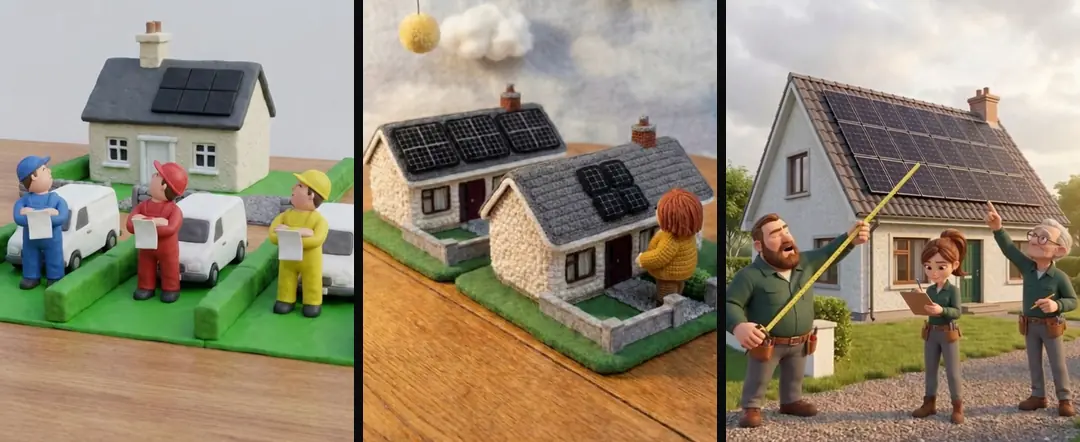
A new hook on a proven body. When only one word changes, such as a city, a language or an offer, it lives in the hook alone. The body is identical across versions and is edited and timed once. Each version replaces only the hook clip in front. Hook captions are timed to that hook’s own audio, since in our runs the lengths differed by tenths of a second. We check every version: its length is within about a third of the master hook’s, the file is not empty, and the files differ from each other by hash, so we know the voice step really ran.
There is a trap. A script that regenerates “what is missing” can regenerate the body when only the hook is missing, and in our runs, regenerating the voice gave a different take each time, so you get a different body than the one you approved. Touch only the hook file. The whole method is in how to iterate on winning ads.
A new voice. Make one good read, tighten it, run it through speech-to-speech to get other voices, and normalize loudness last. In our runs, that order cost less and gave cleaner sound than tightening afterwards, and the ads stopped sounding alike. Keep voice and face matched in energy, and re-pair a voice before you reject it.
A new angle or format. The same research can support different angles with varied b-roll and believable creators. Our own factory works in six formats, so a new angle can also mean a new look, such as a clay world or a talking head. How to make AI UGC ads shows the whole chain.
What to do first when results slide
- Check the status in Ads Manager, and whether your ad set has one creative, since Meta’s flag covers only those.
- When you add a new ad, keep the original running instead of pausing it, as Meta’s note suggests.
- Decide which lever fits. If only the opening is stale, change the hook. If every ad shares one concept, change the angle.
- Build two or three versions that differ on purpose from a library you already own, rather than reshooting.
- Change one thing per test, so you can read the result.
Keep a log so clips don’t repeat
The fourth lever is a rotation rule. Pick the least-used clips that match the beat, break ties at random, set a reuse cap, and keep one shared log that survives until the next script. Brand screens are meant to repeat, because they show the same funnel. Creator clips and generic clips rotate. The log needs little: for each clip, the beats it fits, how many times it has been used, when it was last used and its tier, meaning creator, brand screen or generic.
The rotation rule
- 01Clips that match the beat
- 02The least-used one
- 03Ties at random
- 04Under the reuse cap
- 05Written to one shared log
Back to 01
Before any new generation, look in the library. Only the beats the library lacks get made. Reuse limit and clip log Coming is what we are building for this: a cap on how often a clip appears, and a log across ads. Make what’s missing Early access is how we make the rest in early access, library first. Early access: we set it up with you. Coming: we’re building it. The practice is written up in a b-roll library for ads.
Hooks are the bottleneck
Clips are cheap in quantity. In our library work, hooks were not. Measure a library in unique hooks rather than in clips, and limit how many come from one creator, so a single face doesn’t fill every ad. Your strongest source of new hooks is your own ads: UGC hook ideas shows how to read the first three seconds of the ads you ran. Hook finder Coming is the plan to put the first seconds of your strongest and weakest ads side by side.
Old footage can help too. If you shot a lot for earlier ads, how to repurpose video ads explains how to find the clean footage behind them.
Test what you make, one change at a time
More versions only help if you can tell what worked. Change one thing per test, or you can’t attribute a difference to anything. A new hook on an unchanged body is an iteration, not a new concept. Write down what you expect before the ad is made, so a result has something to be compared with. Creative testing on Meta covers the process, including why a person presses go.
Which testing question are you trying to answer?
Use the detailed guide for the task in front of you. Each owns one question, so you can work through a specific production decision and return to this overview for the wider workflow.
- Hook vs hold metrics
- Synthetic persona pairs
- Useful creative variety
- Andromeda and production
- City and language versions
- Test hypothesis logs
- Unclear test results
- Clip reuse planning
Who wrote this We made the ads first, for SmartSolar in Denmark, Sweden and Ireland. Then we built Turntake. Where Turntake comes from
FAQ
What is creative fatigue in Meta ads?
Meta describes it as an audience having seen the same creative too many times, so people may be less likely to engage and each result can cost more. We read it as a repetition problem, not a verdict that the concept was bad. Meta’s own help page, checked October 2026, explains how it flags the problem.
How do I check for creative fatigue?
In Ads Manager, Meta shows a “Creative limited” or “Creative fatigue” status in the Delivery column of an ad set or ad, once the campaign is active. Meta says this feature covers only ad sets with one creative, so it won’t flag everything. Compare how results change over time as well.
How often should I make new creatives?
There is no honest fixed schedule, because it depends on your audience size, your budget and the ads themselves. We don’t give a number of days. Build a steady flow of genuinely different ads from a library you can reuse, so you are never forced into a rushed reshoot when results slide.
Is a new hook enough?
It is often the cheapest first try, but Meta’s recommendation is a new ad whose image or video is materially different from the original. A new hook on a proven body changes the first seconds, which people see first. If results still slide, change the angle, the format or the b-roll too.
Can AI help with creative fatigue?
It helps with the production side: more hooks, new voices and new formats from the same research, built from a library you reuse. It does not fix a weak concept, and it can make fatigue worse if every ad has the same structure. In our scripts, low variance was the clearest sign of AI, so vary on purpose.
Sources
- Meta Business Help Center: About creative fatigue recommendations in Meta Ads Manager checked 10 October 2026
- Meta Business Help Center: About ad relevance diagnostics checked 10 October 2026
Facts from the sources below were checked on the date shown. Pages change, so read the source again before you rely on it.