Testing and scalingGuide
Creative testing on Meta: one change, a written guess, and you press go
Short answer
Change one thing per test and write down what you expect before the ad is made, so any difference can be traced. Pretests can filter a pair, but real delivery decides. Keep a person on the button: everything goes up paused, and someone switches it on after a final check.
A creative test that changes the hook, the voice and the footage at once can tell you that something worked, but not what. Our process for testing our own ads is plain. Change one thing per test, and write down what you expect before the ad is made. Without both, a result is hard to read.
What does changing one thing at a time look like?
A new hook on an unchanged body is a test of the hook. A new hook, a new voice and a new call to action at once is a test of nothing you can name, because a difference can’t be traced to any single change.
| What you change | What it tests | What stays fixed |
|---|---|---|
| The hook | Whether the opening holds attention | Body, voice, captions, call to action |
| The voice | Whether the delivery changes how the ad lands | Script, edit, visuals |
| One b-roll beat | Whether that picture carries its line | Script, voice, order of beats |
| The call-to-action shot | Whether the last step is clearer | Everything before it |
| Caption style | Whether the ad reads better with the sound off | Everything else |
Source: our own production rules, October 2026.
Meta describes its own A/B test in similar terms. You compare two versions by changing a variable such as the ad images, the ad text, the audience or the placement, and Meta shows each version to a different part of the audience, so nobody sees both (Meta Business Help: About A/B testing, checked October 2026). Meta also advises choosing a hypothesis before you choose a variable, and it recommends against testing informally by turning ad sets or campaigns on and off by hand.
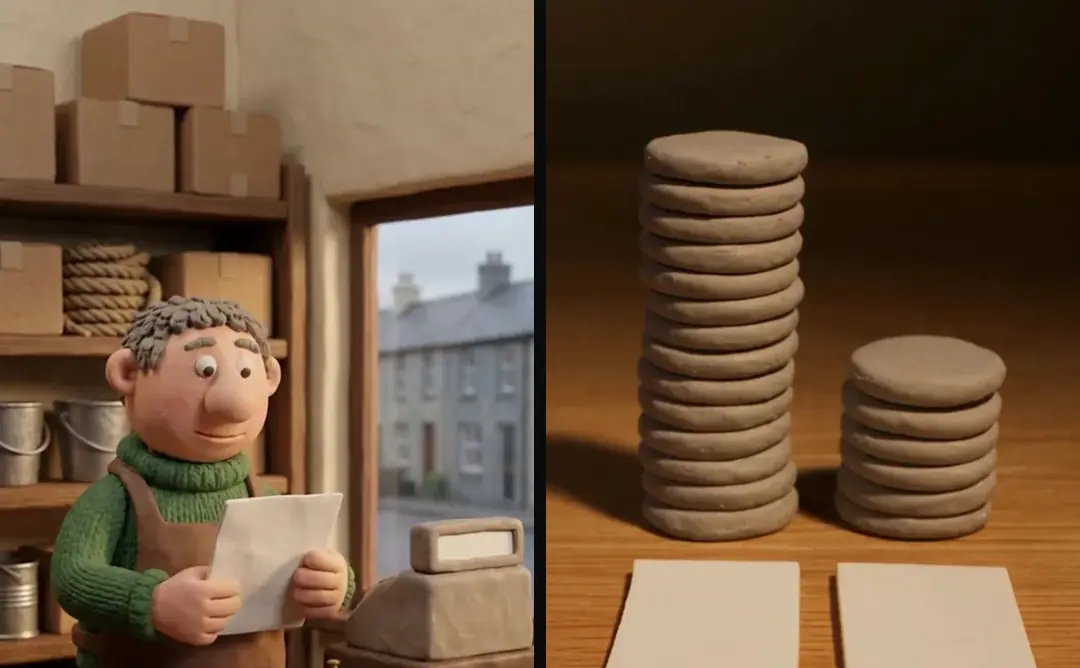
Why write the guess first?
Write down what you expect, and why, before the ad is made. For example: an opening that names the problem will hold people longer than one that names the product. A good guess is specific enough to be wrong.
Written afterward, a guess fits any result. Once the numbers arrive, almost anything can be explained. Written first, it can fail, and a failed guess teaches you something about your audience that a lucky win does not.
- A guess written firstSpecific enough to be wrongA guess written afterwardFits any result
- A guess written firstCan fail, and teaches you somethingA guess written afterwardExplains whatever happened
- A guess written firstLives in a fileA guess written afterwardLives in a chat
We write the guess in a file, not in a chat, because a chat is not a memory. When the result comes in weeks later, the file still says what we expected and why. The mechanics of a clean variation are covered in how to iterate on winning ads.
In our production in October 2026, synthetic personas compare two versions and explain a preference. That is a source of questions for a real test, rather than a forecast about an audience. The dedicated pair pretest guide covers its limits. Pair pretest Coming remains a planned feature, and the hypothesis log records what an observed test would need to establish. Early access: we set it up with you. Coming: we’re building it.
Our pair pretest
- 01Two versions of one ad
- 02Ten fixed synthetic personasBalanced order
- 03Each must pick one
- 04A script aggregates
- 05You read the raw commentsYou
Why don’t we publish rules for turning an ad off?
Because the rule we used earlier did not hold up. One signal alone misleads. In our own data, a high stop rate, meaning how many people stopped scrolling in the first seconds, did not reliably predict which ads did the job we wanted. So we look at the whole funnel, and we don’t publish cut-offs, thresholds, budgets or test lengths that we can’t stand behind.
What happens before an ad goes up?
Four things happen before anything goes live.
A mechanical check. A lint runs our house rules against the plan before anything is handed over: a cut in the first 4 s, enough cuts overall, the real form or screen on the call-to-action shot, clips trimmed to length and reuse limits. Every final video also gets a machine-readable recipe, and a check has to be green before the round counts as done. The full list is in our video ad QA checklist.
A mute test. Watch the ad with the sound off. The picture and the on-screen text alone should say what the ad is about and what to do next.
No new claims. Captions and highlights never add a number or a promise that isn’t in the approved voiceover. In our own review app, a word that is a claim is locked and can’t be edited.
A person on the button. Everything is created paused. The ad account is read-only for our analysis, and anything that can cost money or change an account needs a yes from a person. Nothing goes up or goes live without you pressing go, which is one of the house rules we hold ourselves to.
- 01A mechanical checkAgainst the plan
- 02A mute testPicture and text alone
- 03No new claimsCaptions add nothing
- 04A person on the buttonCreated pausedYou
How do results feed the next round?
A result is only useful if it changes what you make next. A hook that held up becomes the starting point for more hooks, so read UGC hook ideas from our own ads for where those come from. A winning body becomes the base for several openings, which is the subject of iterating on winning ads.
And when a winner stops working, look at the whole set before you blame one ad. Creative fatigue on Meta covers how a set of ads can wear out together, and why a set of winners is a portfolio and not one concept.
What should the next test resolve?
Write the decision that the team will make after reviewing the result. An opening comparison can help choose what to produce next, but it does not establish why a whole campaign changed. Keep the observation window, placement and audience context with the creative version so that a later reviewer can understand the comparison.
If the evidence is mixed, record that uncertainty rather than forcing a winner. The test hypothesis log keeps the question and the planned observation together. The confounders guide explains when another variable prevents a confident interpretation. The next round should resolve that uncertainty with a smaller, clearer question.
Who wrote this We made the ads first, for SmartSolar in Denmark, Sweden and Ireland. Then we built Turntake. Where Turntake comes from
FAQ
What should I test first?
Test the hook first. The opening is the part viewers meet before anything else, and it is the cheapest part to change, because the body stays the same. Write down your guess, change only the hook, and keep the voice, the edit and the call to action identical, so a difference can be traced to the opening.
Can AI personas predict which ad will win?
Not as a forecast. In our process, ten synthetic personas see two versions in a balanced order and must pick one. That matched the real outcome on two of two known pairs, which is a direction from a small sample. Rating a single ad ranked known losers highest, so we only use pairs.
Should an AI agent launch my tests?
We don’t let one. In our setup, agents read the ad account but cannot change it, every upload is created paused, and a person switches it on after a final check. Anything that can cost money or change an account needs a yes from a human.
Why don’t you publish rules for when to turn an ad off?
Because the one rule we used earlier did not hold when we checked it against our own data. A single signal can mislead, and a high stop rate did not reliably predict which ads did the job. We look at the whole funnel instead, and we don’t publish cut-offs we can’t stand behind.
Sources
- Meta Business Help: About A/B testing checked 10 October 2026
Facts from the sources below were checked on the date shown. Pages change, so read the source again before you rely on it.