ClaudeGuide
Validate AI video ad outputs before human review
Short answer
Validate an AI video ad in layers: recipe structure, source media, rendered streams, duration, captions and required graphics. Tie the report to the output hash and distinguish machine failures from editorial judgments. Return a compact defect report and a meaningful exit status, then let a person review whether the technically valid ad tells the intended story truthfully.
Define what the validator can establish
A validator can confirm declared structure and measurable output properties. It cannot establish every product claim or decide whether a visual metaphor is appropriate simply because a file passes. A useful report identifies the exact output, failed condition and evidence needed to decide which review should happen next.
In our production in October 2026, measurable checks run separately from creative review. claude for ads gives the Claude context. ffprobe exposes media properties, and Claude Code permissions concern what a worker can execute. The gate design here is a recommended production method that keeps those measurable checks separate from authority and editorial acceptance.
A hypothetical vacuum render passes its stream, duration and decoding checks, but includes a capability claim with no supplied supporting record. The validator can report the technical passes accurately while leaving factual approval open. That is more useful than one overall green label. Keep the exact output identity with both results, so an operator can see which machine checks succeeded and which human decision still prevents the package from being accepted.
Check schema version, required fields, allowed operations, time units and referenced asset IDs. Resolve source files and inspect whether selected intervals exist. Fail early when the recipe cannot describe a complete cut.
Do not accept a misspelled field silently if it could omit the intended operation. A required graphic needs a declared source and timing; a music bed needs a resolvable asset and treatment. In our October 2026 production, the recipe binds to the final hash. Keep the validator’s input hash as well, so a report cannot remain green after someone changes the recipe or replaces an asset under the same path.
| Check | Suggested action |
|---|---|
| Structure | Validate schema and units |
| Media | Check streams and duration |
| Layers | Require captions and factual graphics |
| Report | Tie findings to output hash |
Source: Turntake editorial checklist (proposed), October 2026.
Inspect streams and duration
Confirm that the intended video and audio streams are present and that the duration matches the recipe within the defined production tolerance. State the tolerance in the contract instead of inventing one after observing a discrepancy.
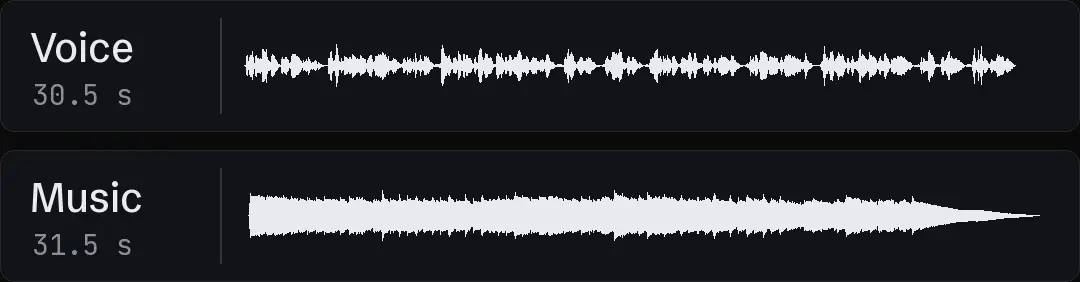
A playable video can still have the wrong audio stream, a truncated ending or an unexpected frame size. Decode representative material and inspect the ending, especially when looped graphics or independent audio inputs are involved. A probe report establishes reported properties, not the correctness of every pixel. Keep that scope clear in the output so another operator does not read “streams valid” as approval of the whole creative.
- 01Check recipeResolve required references
- 02Inspect rendered mediaConfirm streams and duration
- 03Check cues and layersLocate measurable defects
- 04Write scoped reportHand off editorial review
Check captions against the actual voice
Verify cue structure, time order, bounds and expected text. Then compare sampled audible words with their displayed timing. A cue file can be syntactically valid while following an older recording.
In our production in October 2026, the rendered voice is the timing reference and the standard script supplies display spelling. Keep pronunciation input out of the caption text. Check negations, names and factual wording explicitly. A machine can report an unexpected word or a cue outside the media duration; a reviewer may still need to decide whether a transcription difference is an error. Return that uncertainty rather than changing the approved wording automatically.
Require declared graphics to remain present
The recipe should identify essential labels, cards and qualifications. Check their expected intervals and inspect representative rendered frames. A graphic file on disk is not evidence that it survived the final composition.
In our October 2026 production practice, render-and-see checks remain after technical fixes. Treat an unsupported layer as a failed gate rather than an optional omission. A required qualification disappearing is a content defect even if the rest of the video plays correctly. Keep the failure located by asset, interval and layer ID so the repair author can reproduce it without searching the whole timeline.
- Machine findingAudio stream missingSeparate judgmentDoes voice suit the scene?
- Machine findingCue outside durationSeparate judgmentIs grouping comfortable?
- Machine findingRequired label absentSeparate judgmentIs the claim supported?
- Machine findingHash mismatchSeparate judgmentWhich revision should be approved?
Report failures with useful categories
Return a non-success status for a failed required gate and distinguish invalid input, missing media and invalid output in the report. The exact exit codes belong to the project’s documented interface. A downstream process should not infer success merely because a report file was written.
Retry AI generation jobs without submitting twice covers external generation request recovery. Can Claude edit video ads? Render from an edit file covers Claude editing an existing cut, and Connect ElevenLabs to Claude for ad voiceovers covers preparing an approved voice sample. Those are upstream or adjacent tasks, not responsibilities the validator should perform while checking a submission. Keep the reviewer readable and the author repairable: a validation pass reports evidence instead of silently changing the media it was asked to inspect.
Hand off a technically valid candidate
Include output hash, passed gates, failures, warnings and untested areas. A warning should explain its consequence, not merely say that something looked unusual. The human reviewer then checks message, factual support, performance and the intended action.
Turntake’s model plans describes Turntake’s model plans. This article describes studio gates and a proposed validation contract, not an already available automatic checker for arbitrary customer clips.
For a suggested acceptance fixture, create copies with one missing audio stream, one out-of-bounds caption and one omitted required label. Each should fail its own gate with a concise explanation. A clean fixture should pass the mechanical gates while still being labeled as awaiting editorial review. This tests that success and failure mean the same thing to the author, renderer and final approver.
Keep warnings from becoming hidden acceptance
Suppose the validator cannot inspect a required graphic because its comparison reference is unavailable. Mark that gate untested and explain the missing input. Do not downgrade it to a harmless warning merely to return an overall green state. A required check needs either supporting evidence or a visible unresolved condition. This proposed rule makes the report useful to the approver, who can request the missing reference or explicitly change the acceptance criteria before treating the candidate as ready for review.
Who wrote this We made the ads first, for SmartSolar in Denmark, Sweden and Ireland. Then we built Turntake. Where Turntake comes from
FAQ
What should an AI video ad validator check?
Validate an AI video ad in layers: recipe structure, source media, rendered streams, duration, captions and required graphics. Tie the report to the output hash and distinguish machine failures from editorial judgments. Return a compact defect report and a meaningful exit status, then let a person review whether the technically valid ad tells the intended story truthfully.
How do I validate the recipe before reading every frame?
Check schema version, required fields, allowed operations, time units and referenced asset IDs. Resolve source files and inspect whether selected intervals exist. Fail early when the recipe cannot describe a complete cut.
How do I inspect streams and duration?
Confirm that the intended video and audio streams are present and that the duration matches the recipe within the defined production tolerance. State the tolerance in the contract instead of inventing one after observing a discrepancy.
How do I check captions against the actual voice?
Verify cue structure, time order, bounds and expected text. Then compare sampled audible words with their displayed timing. A cue file can be syntactically valid while following an older recording.
Sources
- FFmpeg: ffprobe documentation checked 11 October 2026
- Anthropic: Claude Code permissions checked 11 October 2026
Model facts come from each maker’s own documentation, checked on the date shown. Models change, so read the source again before you plan a batch.