ModelsModel guide
ElevenLabs for ad voiceovers: words, pace, pauses, pronunciation and music
Short answer
Write the script twice: once for the eye, for the captions, and once for the mouth, with numbers spelled out and no abbreviations. Generate two takes and keep the one speech-to-text reads closest to the script. Fix pace and pauses in the text and the trim, and normalize loudness last.
In our own ads, an AI voiceover gave itself away in the numbers, the pauses and the pace, and we fixed most of it in the script before we touched a setting. Voice is one step in the whole AI UGC workflow, and in October 2026 we voiced our scripts with Eleven v4. The settings and habits below are our own choices, not ElevenLabs’ recommendations. What we say about the product itself comes from ElevenLabs’ documentation, with a link.
How many words fit the ad?
Start from the length, not from the script. Seconds equal words divided by words per second, so a script has to be budgeted before anyone records it. We plan Danish at about 3.75 words per second, then check against a real take.
In our tests in October 2026, Eleven v4 read number-heavy English business copy more slowly than that. A script of about 100 spoken words, including the call to action, came out at about 40 seconds. That is one measurement, in one language, on one kind of text. Measure your own: generate one take, time it and adjust the word count.
100 spoken words
ElevenLabs also has a speed setting from 0.7 to 1.2, with 1.0 as the default, and its text-to-speech guidance notes that extreme values can affect quality. We shorten the script before we touch the speed.
Two versions of every script
The eye version feeds the captions, and the mouth version feeds the voice. We write the standard script first, with normal numbers, punctuation and the brand name, and make the mouth version separately.
| Eye version | Mouth version | Why | |
|---|---|---|---|
| Numbers | 1,500 | fifteen hundred | ElevenLabs notes that some models read numbers more naturally than others, so we don’t leave it to chance |
| Abbreviations | e.g. | for example | ElevenLabs recommends expanding abbreviations to their spoken form |
| Web addresses | brandname.com | Brandname | A spoken address sounds stiff, so the domain becomes the brand name |
| Emphasis | VERY | very | ElevenLabs says capitals add emphasis in Eleven v4, so we leave stress to the take |
Source: our own production rules, October 2026, and ElevenLabs docs, checked October 2026.
Captions always use the eye version. We lay its words over the word times from the audio, so the captions follow the sound and not the script document.
Pauses, tags and pace: what the docs say, and what we do
ElevenLabs’ docs are specific about pauses on the newer models, and they differ from older advice. This is the part that matters for ads:
| Technique | What the docs say | Applies to |
|---|---|---|
| SSML break tag | Not supported; use other techniques | Eleven v4 and v3 |
| Ellipsis | Adds a pause and weight | Eleven v4 |
Line break or [pause] | Listed, with the ellipsis, as ways to add a pause | Eleven v4 |
Audio tags such as [whispers] | Direct the delivery; in v3 a tag can be spoken aloud when the voice doesn’t fit the delivery | Eleven v3 and v4 |
| Speed setting | 0.7 to 1.2, default 1.0 | Text-to-speech settings |
Source: ElevenLabs text-to-speech guidance and Audio Tags 101, checked October 2026.
In ads, most of our pause work happens after the voice is generated, in the trim. Raw silence removal clips soft consonants and leaves seams. So we cut pauses in the middle, keep the room tone, tighten long pauses to about 0.35 seconds and bring loudness to −14 LUFS with a −1 dBTP ceiling as the last step, after a voice change.
In our production in October 2026, a short voice sample is checked before the video is made, and spoken spelling can differ from the caption spelling. The dedicated pronunciation guide covers dictionaries, model-specific support and review by a speaker of the language. A word that looks correct in a transcript can still sound wrong, so the written check and the listening check serve different purposes.
Pick the take with speech-to-text, not only by ear
We generate two takes per script, compare each take’s transcript with the script and keep the one with the fewest deviations. If they tie, the shorter one wins. Then we normalize loudness. Our defaults are Eleven v4 with stability at 0.5 and similarity at 0.75, and they are our choices, not an ElevenLabs recommendation.
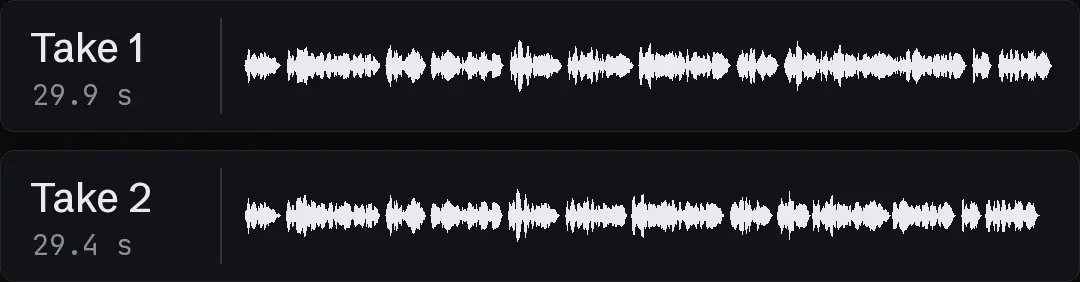
We keep a fixed voice per market, cast by gender, age and persona. We haven’t listened through every voice yet, so we say nothing here about how natural a voice sounds. Judge that by listening, in your market. Loudness, caption lines and the other house rules are in our video ad QA checklist.
Variation from one good read
Instead of generating a new read for every voice, we make one good read, tighten it and run it through speech-to-speech for other voices. The order matters: tighten first, change the voice second, normalize last. It is cheaper than tightening afterwards, and the audio comes out cleaner. ElevenLabs describes its voice changer as turning a recording into a different voice while keeping the delivery.
- 01One good read
- 02Tighten the pausesTo about 0.35 s
- 03Change the voiceSpeech-to-speech
- 04Normalize last−14 LUFS, −1 dBTP
When the voice changes on an ad that is already cut, we don’t rebuild the edit. We map the old voice’s words onto the new one and move the existing beats to the new rhythm, as iterating on winning ads describes step by step. We’re building Swap the voice, keep the cut Coming to do this for you. Early access: we set it up with you. Coming: we’re building it.
In our music tests in October 2026, some generated tracks faded before the spoken ending. We asked for a longer bed, trimmed it and checked the last spoken line in the final mix. The dedicated ElevenLabs music guide covers that production method. For the overall arrangement, music and sound effects should support the voice rather than compete with it.
The mix under a 30-second ad
- 11 s fade-out
- Trimmed off
Match the voice to the face
In one reviewed batch, quality varied almost entirely with the pairing of face, voice and script, and the same voice could be the strongest or the weakest depending on the match. So don’t reject a voice after one bad result: re-pair it. AI UGC talking heads covers the face side.
Two account pitfalls from our own work, dated summer to autumn 2026 and possibly out of date: shared library voices returned a voice_not_found error through the API until we added them to our account in the web app, and we dropped one voice parameter that gave an accent in the wrong language.
Turntake’s models page lists Eleven v4 and speech-to-speech under voice, as part of a plan that will change. With Models in Claude Coming you would ask Claude for a voiceover instead of setting up an account at each maker. Seedance vs Kling vs Veo sorts the video jobs of an ad the same way.
Who wrote this We made the ads first, for SmartSolar in Denmark, Sweden and Ireland. Then we built Turntake. Where Turntake comes from
FAQ
How do I add a pause in ElevenLabs?
On Eleven v4 and v3, not with an SSML break tag: ElevenLabs’ docs say those models don’t support them. Use an ellipsis, a line break or the [pause] audio tag instead. For ads we also tighten pauses afterwards in the trim, which lets us control the exact length.
Why is my ElevenLabs voiceover too fast?
Check the speed setting first: it runs from 0.7 to 1.2, with 1.0 as the default, and ElevenLabs notes that extreme values may affect quality. Then treat it as a length problem. A script with too many words for the time forces a rushed read, so divide the words by your measured pace and cut before you touch the speed. In our tests, number-heavy copy ran slower than planned, not faster.
How do I fix how a brand name is pronounced?
Write the spoken form into the script the way a person would say it, then test it with speech-to-text. ElevenLabs’ docs describe IPA between forward slashes for Eleven v4, plus alias tags and pronunciation dictionaries for names and acronyms. Results vary by voice, so check a sample with your chosen voice before you build video around it.
How loud should a voiceover be in an ad?
In our ads the finished mix is normalized to −14 LUFS with a −1 dBTP ceiling. That is our house rule, not a platform requirement. We normalize last, after any trim or voice change, and keep the music bed well under the voice so the words stay clear.
Can ElevenLabs make the music bed too?
Yes. According to its docs, ElevenLabs’ music model can make instrumental tracks or tracks with vocals, from 3 seconds to 5 minutes. In our tests it added a fade-out by itself, so we ask for no ending, make the track longer than the video and trim it ourselves.
Sources
- ElevenLabs docs: Text to speech, writing for the voice checked 10 October 2026
- ElevenLabs: Audio Tags 101 checked 10 October 2026
- ElevenLabs docs: Speech to text checked 10 October 2026
- ElevenLabs docs: Eleven Music checked 10 October 2026
- ElevenLabs docs: Voice changer checked 10 October 2026
Model facts come from each maker’s own documentation, checked on the date shown. Models change, so read the source again before you plan a batch.