ModelsGuide
ElevenLabs music for ads: plan the full music bed
Short answer
Plan a music bed around the approved voice, not around a standalone song. Specify restrained instrumentation, steady energy, and the role of the ending. In our October 2026 production, generated endings faded early, so we requested extra length and trimmed deliberately. Audition the final seconds as well as the overall level.
The music reaches its ending while the narrator still has a sentence to finish. Avoid that mismatch by briefing the bed against the spoken structure, including density, accents, and the intended close. Inspect the actual generated track’s duration and arrangement, then keep the source separate from the final mix so timing remains adjustable.
Describe the job of the music
ElevenLabs’ ElevenLabs: music prompting recommends specifying musical attributes such as mood, instrumentation, and tempo. For an ad bed, add the practical role: supporting a voice-led explanation with a stable level of activity. This is more useful than asking for a dramatic track and hoping it stays behind the words.
The ElevenLabs: compose music API documents the request interface and duration-related controls. Check the actual endpoint and model you plan to call instead of copying settings from an old example. The production method here does not depend on a particular maximum duration. It depends on getting enough usable material around the spoken cut.
Lock the voice before choosing the bed
Place the approved voice on the timeline and mark its pauses, emphasis, and final action sentence. Listen without music first. If the explanation is rushed or unclear, music is unlikely to repair it. Speech to text for captions: time every word covers the word-level timing that makes those boundaries visible.
Identify where the bed may become more noticeable: an opening without speech, a demonstration pause, or a final picture hold. Those moments can tolerate different energy from a dense sentence. Avoid interpreting every pause as an invitation for a musical accent. Some pauses exist so the viewer can understand the spoken point.
| Voice moment | Suggested music instruction |
|---|---|
| Dense explanation | Restrained arrangement, no competing lead line |
| Short demonstration pause | Maintain continuity rather than start a new section |
| Final action sentence | Keep energy available under the complete line |
| Picture tail | Leave material that can be trimmed and faded |
Source: suggested production checklist, October 2026.
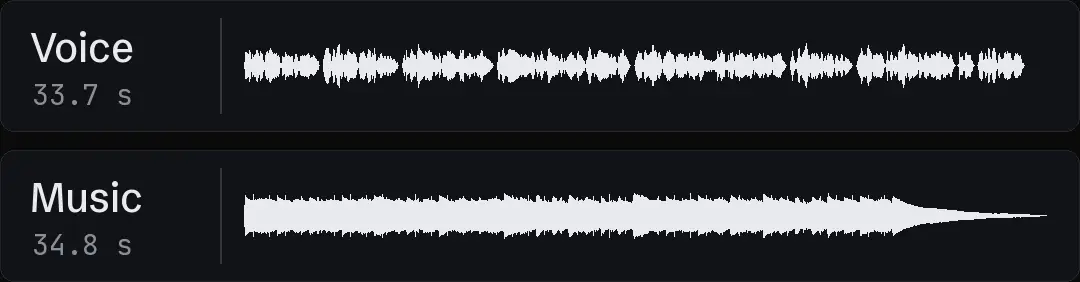
Ask for a bed, then listen for structure
A hypothetical brief might request warm muted percussion and a soft sustained texture, instrumental only, with no major build or drop. Those are proposed production choices. The correct combination depends on the product and voice; the prompt is not a promise about the returned arrangement.
Listen to the whole output for unexpected vocals, a prominent melody, or an abrupt section change. A track can meet the stated genre and still interrupt the argument. Keep notes by time interval so a rejected arrangement has an actionable reason. “The lead enters under the product explanation” is more useful than “the mood is wrong.”
In a hypothetical storage-box ad, the musical decision sits at the close, where the narration still needs space after the action finishes. Brief that relationship instead of asking only for a mood. When the source arrives, listen to its own ending before applying a timeline fade. A fade already built into the music can change the intended close, so retain the source and judge the combined ending in the actual edit.
Reserve material beyond the video end
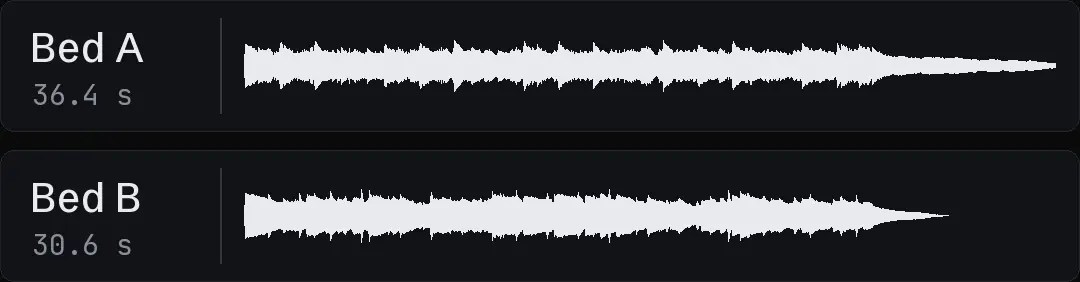
In our production in October 2026, ElevenLabs music outputs added a fade at the end even when that was not the intended structure. Our production response was to request “no ending, no fade-out,” ask for roughly fifteen extra seconds, and trim the bed ourselves.
That is a dated observation and our chosen edit allowance, not a universal model behavior or an API requirement. Audition your own returned file. If its usable steady section ends before the ad, a longer request may help, but the important decision is where to take the final bed from the actual audio.
Trim a musical region that supports the cut
Choose the region after listening, then align it with the edit. A clean start may begin after the file’s first transient or silence. Keep a little extra source material at each end so adjustments do not require another generation whenever the voice shifts slightly.

Do not loop an obvious phrase merely because the track is short enough to duplicate. Repeated accents can become distracting under the same spoken cadence. If repetition is necessary, listen across the join at normal playback and with the voice present. The edit’s rhythm, rather than the file boundary, should determine the placement.
- 01Approve the voiceMark pauses and ending
- 02Brief the bedInstrumentation and steady energy
- 03Choose a usable regionPreserve extra tail
- 04Render and auditionInclude the final seconds
Mix for comprehension before mood
Bring in the bed beneath the voice and check the least intelligible sentence. Our documented mix choices are house choices, not instructions from ElevenLabs or a platform. In our production in October 2026, a very quiet bed could disappear in the finished mix, so listening mattered alongside meter readings.
Test on the speaker the viewer is likely to use, including a small phone speaker. A low sustained sound that is clear on headphones may barely register there, while a sharp instrument can dominate. Change arrangement or equalization when needed instead of raising the entire bed until it interferes with speech.
- Standalone track decisionInteresting arrangement on its ownAd-bed decisionUnderstandable speech over the arrangement
- Standalone track decisionFile ends at the cutAd-bed decisionEditor chooses the usable tail
- Standalone track decisionOne overall meter readingAd-bed decisionListening through the final sentence
Audition the ending deliberately
Play the last sentence and picture tail together. Listen close to the end, not just to an integrated loudness measurement. In our production in October 2026, checking the level about 0.2 seconds before the end helped identify a bed that had faded away before the intended close.
Decide whether the final picture needs a short fade, a held tone, or a clean musical finish. Then render and listen again. A correct timeline fade can be obscured by an earlier fade already present in the source. The audible file, not the control setting, is the evidence.
Keep music replaceable
Save the source track, chosen interval, mix adjustment, fade placement, and approved voice as separate items in the edit recipe. Replacing a visual shot from Kling for ads: a shot test based on its docs or Veo for ads: plan shots and generated sound should not require reconstructing the background bed from a flattened export.
seedance vs kling vs veo provides the broader model context, and Turntake’s models plan labels Turntake’s model connection as Coming. This is a method for producing an editable music bed with checked documentation and dated observations. It does not assert that music generation, auditioning, or automated mix approval is already a self-service Turntake feature.
Who wrote this We made the ads first, for SmartSolar in Denmark, Sweden and Ireland. Then we built Turntake. Where Turntake comes from
FAQ
Why request music longer than the ad?
Extra material leaves room to choose a steady section and make an intentional ending. Our October 2026 method used roughly fifteen extra seconds after early fades appeared. That allowance is our edit choice, not a vendor requirement.
Can a prompt prevent every unwanted fade?
A prompt can express the intended structure, but inspect the returned audio. Our production observation was that endings sometimes faded despite the intended brief. Choose and trim usable material rather than assuming the instruction settled the result.
Should I select music before the voice?
Approve the voice first so the bed supports the actual pauses, emphasis, and ending. You can collect references earlier, but mix against the final spoken timing. A strong standalone track may still compete with the explanation.
What belongs in the music handoff?
Keep the source track, selected interval, mix level, fades, and voice reference separately. Add ending-review notes. Those details make a later voice revision or clip replacement possible without extracting music from a flattened video export.
Sources
- ElevenLabs: music prompting checked 11 October 2026
- ElevenLabs: compose music API checked 11 October 2026
Model facts come from each maker’s own documentation, checked on the date shown. Models change, so read the source again before you plan a batch.